The Pune real estate market in 2026 doesn’t ask you to take anyone’s word for it. The numbers make the case. The city recorded over 1.58 lakh property registrations in 2024 – the highest in recent years – and 2026 is tracking in a similar direction, backed by the same structural drivers: a dense IT employment base, metro expansion already underway, and a buyer profile that’s increasingly driven by actual end-users rather than speculators.
If you’re evaluating a property purchase in Pune this year, this is what the market actually looks like – not the optimistic brochure version, but the version that helps you make a better decision.
The Employment Story Hasn’t Changed – It’s Gotten Stronger
Pune’s real estate market is anchored in something most other Indian cities lack: a job market that keeps pulling people in from across the country.
Maharashtra’s GCC Policy 2025 targets 400 new Global Capability Centres and approximately 4,00,000 high-skilled jobs across the state. Pune, which already hosts over 360 GCCs according to industry estimates, is positioned as one of the primary beneficiaries of this expansion. That’s a sustained pipeline of professionals – each of whom needs a place to live within a reasonable commute from Hinjewadi, Kharadi, or Baner.
This employment density is also why Pune’s rental market holds up. Areas like Wakad, Tathawade, Baner, and Kharadi consistently post rental yields between 3% and 5% annually – which is what makes these locations interesting for both end-users and investors simultaneously.
Infrastructure: What’s Operational, What’s Coming
Metro Phase 1 – connecting PCMC to Swargate and Vanaz to Ramwadi – is already running. This matters more than the “upcoming” sections of any Metro plan because operational infrastructure has already begun affecting property absorption along those corridors.
Metro Line 3 (Hinjewadi to Shivajinagar) is the next significant milestone. When that corridor becomes operational, it will directly lift buyer demand in West Pune’s most active residential belt. Buyers evaluating Wakad, Tathawade, and Mahalunge right now are, in effect, buying ahead of that infrastructure delivery – which is historically when the best entry prices are available.
The 170 km Ring Road project is moving through the approval and execution phases. Its completion will significantly reduce cross-city travel times and open up micro-markets along its corridor that currently suffer from commute friction.
One thing worth stating plainly: infrastructure delivery in India runs on its own timeline. Don’t buy solely on the basis of a project that isn’t built yet. Buy where the existing fundamentals already work – and treat future infrastructure as upside, not the primary thesis.
What’s Actually Happening to Property Prices?
Pune’s price appreciation in 2026 is best described as steady rather than spectacular – and that’s actually a healthier signal than the rapid run-ups that precede corrections.
Micro-markets with strong employment proximity and metro access are outperforming peripheral locations. Localities like Baner, Balewadi, Kharadi, and Wakad have seen consistent year-on-year appreciation in the 7–10% range, according to MagicBricks and Housing.com market tracking data for 2025–26. More affordable corridors like Tathawade and Mahalunge are seeing stronger absorption growth, as buyers priced out of the premium west Pune belt move slightly further along the same corridors.
Premium and luxury housing is a separate story. Demand for larger homes – 3 BHK and above, with curated amenities – has increased meaningfully since 2022. The hybrid work culture permanently shifted buyer preferences toward space, and that shift has held. Premium projects in central, well-connected localities like Mukund Nagar are seeing strong absorption precisely because new supply in already-established central addresses is limited.
Mukund Nagar: Why Central Pune Is Back in the Conversation
The story of Pune’s real estate market used to be almost entirely about the western IT corridor. That’s changing.
Mukund Nagar – a mature, well-serviced South-Central locality with direct access to Pune Railway Station, Swargate Metro, MG Road, and Camp – is seeing renewed buyer interest for a specific reason: supply scarcity. Unlike Hinjewadi or Kharadi, you can’t just launch unlimited new inventory in a locality like Mukund Nagar. That constraint supports price stability and long-term value retention.
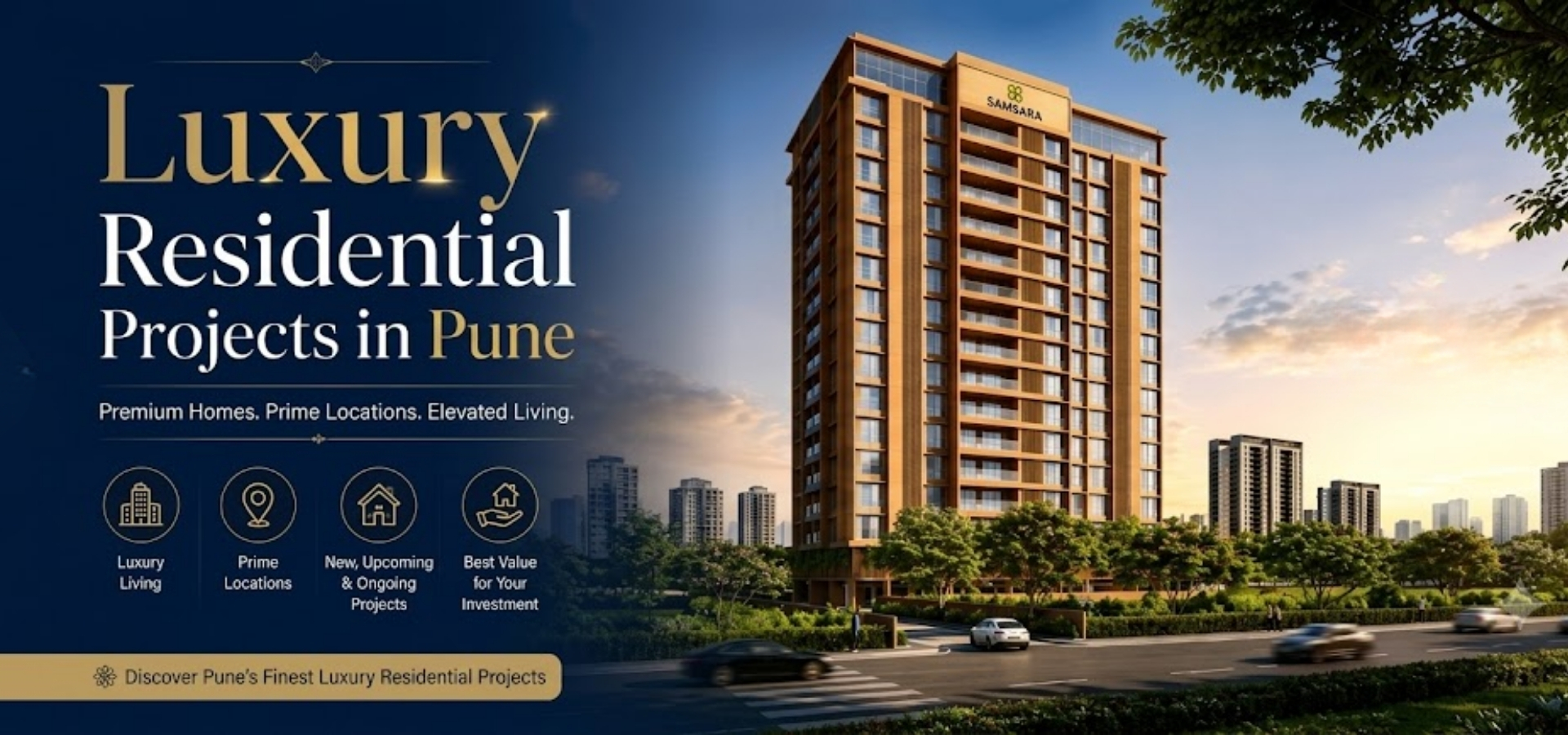
Abhinav Group’s Samsara project in Mukund Nagar – offering 3 BHK flats across 1,102 sq. ft. and 1,409 sq. ft. configurations, 14 floors, 4-level parking, and 16,000 sq. ft. of lifestyle amenities (MahaRERA: P52100079797) – reflects exactly this thesis: a premium product in a supply-limited central address, designed for buyers who want quality of life and location stability in equal measure.
Risks Buyers Need to Price In
Any honest market overview includes the downside. Here’s what buyers should genuinely assess in 2026:
Infrastructure timeline risk – Projects that haven’t broken ground yet may still be 3–5 years away from delivery. Don’t pay a premium for infrastructure that isn’t built.
Under-construction delivery risk – RERA has improved transparency significantly, but delays still happen. Verify construction progress in person, not just on the developer’s website.
Oversupply in peripheral locations – Some outer-ring micro-markets have a heavy pipeline of new launches. In those areas, resale liquidity may take longer to develop than sales pitches suggest.
Interest rate sensitivity – Home loan rates in 2026 remain elevated versus the lows of 2021–22. Factor in the actual EMI burden at current rates, not promotional ones.
What Buyers Should Actually Do in 2026
Do the verification work that most buyers skip:
-
- Check every project’s MahaRERA registration at maharera.mahaonline.gov.in before visiting the site office
-
- Ask for the developer’s completed project list and visit at least one delivered project to assess construction quality and post-possession maintenance
-
- Cross-check rental values in your target area on NoBroker or Housing.com – don’t rely on the developer’s rental yield projections
-
- Evaluate the location on a Tuesday morning, not a Sunday site visit
Final Word
Pune’s real estate market in 2026 is not a bubble, and it is not a revolution. It is a steady, employment-anchored market with genuine growth pockets and real risks to navigate. The buyers who make good decisions here are the ones who understand which corridor they’re buying in, why demand exists there, and what the developer’s actual delivery record looks like.
The city rewards patient, well-informed buyers. It has done so consistently for the last decade, and the structural case for 2026 is no weaker than it was in 2023 or 2024.
Explore residential projects by Abhinav Group in Pune →
FAQs
Luxury residential projects in Pune are gaining popularity due to the city’s growing IT sector, expanding metro connectivity, premium lifestyle amenities, and strong investment potential. Homebuyers also prefer spacious homes in well-connected locations with modern infrastructure.
Some of the most sought-after locations include Mukund Nagar, Kharadi, Baner, Balewadi, Hinjewadi, Koregaon Park, Wakad, and NIBM Road. These areas offer excellent connectivity, social infrastructure, and high appreciation potential.
Before investing, verify the project’s MahaRERA registration, developer reputation, location advantages, construction quality, floor plans, legal approvals, possession timeline, and available amenities.
Yes. Upcoming residential projects in Pune often offer attractive launch prices, flexible payment plans, and strong appreciation potential. Choosing a reputed developer and a prime location can maximize long-term returns.
You can visit the official MahaRERA website and search using the project’s registration number or developer name to verify approvals, project status, and legal details before making a purchase.
Premium residential projects typically include a clubhouse, swimming pool, gymnasium, landscaped gardens, children’s play area, indoor games, yoga deck, jogging track, multi-purpose hall, senior citizen zone, and 24×7 security.
Yes. Mukund Nagar is one of Pune’s established residential locations offering excellent connectivity to Camp, Swargate, Pune Railway Station, educational institutions, healthcare facilities, and commercial hubs, making it ideal for both families and investors.
A new launch project has recently been introduced to the market. An upcoming project is in its pre-launch or early development stage. An ongoing project is currently under construction and progressing toward completion.
Samsara by Abhinav Group offers thoughtfully designed 3 BHK residences in Mukund Nagar with premium specifications, modern lifestyle amenities, excellent connectivity, and a MahaRERA-registered development, making it an ideal choice for homebuyers seeking luxury living in Pune.